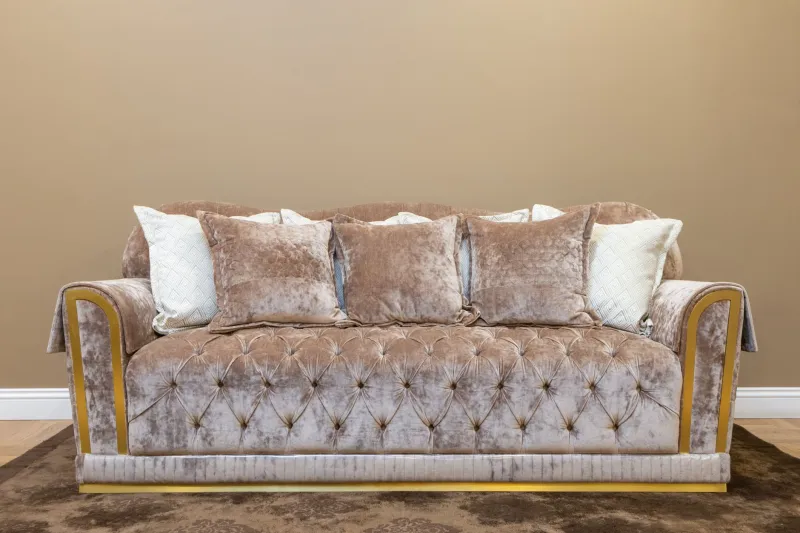
The Free Sofa Isn't Free: A Pre-Move-In Inspection for Secondhand Seats

Photo by Photo by Donald Merrill on Unsplash on Unsplash
There are three ways a free sofa arrives in your life. A relative mentions it down the phone. A neighbour taps the window as a van pulls up. Or a listing appears with the words "free to collector" and a photo taken from an unflattering angle. In all three cases the instinct is the same: a sofa is a big-ticket item, someone is offering one for nothing, and saying yes feels like a small win.
Sometimes it is. A hardwood frame from a good maker can outlast two flat-pack sofas and still have years in it. But a sofa is also one of the few things in a house that must be carried, cleaned, sniffed, insured against and eventually disposed of. Free is a starting price, not a final one. Here's the check we run through before we say yes.
1. Meet it in its own room, in daylight
Go and see it where it currently lives. Daylight shows sun-fade down one arm, water rings from a plant pot, and the faint pale patch where a radiator has been breathing on it for a decade. Pull the cushions off and look at the back and sides — the faces nobody photographs. Ask what's happened on it. People are surprisingly honest about a sofa they're getting rid of.
2. Get your hands on the frame
Lift one front corner about ten centimetres and set it down. Listen. A creak, a knock or a wobble is a joint working loose. Then take the arm and shake the whole thing gently, side to side. A solid beech or hardwood frame moves as one object. A chipboard frame held together with staples will tell you everything you need to know in about four seconds.
3. Turn it upside down
With permission and a second pair of hands. Look at the dust cover: intact or shredded? Look at the corner blocks — glued and screwed, or just stapled? Feel the webbing underneath the seat: firm, or sagging like a hammock? A repair done with wood glue and clamps is fine and often stronger than new. A repair done with parcel tape is a warning. Check the base for damp staining and small round holes; a sofa that lived in a cold garage can arrive with woodworm as a passenger.
4. Find the labels — all of them
In the UK, domestic upholstered furniture has to meet the Furniture and Furnishings (Fire) (Safety) Regulations 1988, as amended. That means a display label and a permanent label, usually sewn into the underside or the back. No labels means you cannot verify compliance, and if money is changing hands the seller is on very thin legal ice. If the labels were cut out because they were "scratchy", note it and move on with your eyes open. Also ask whether the sofa has ever been re-covered — a reupholstered piece has to meet the same requirements as a new one.
5. Sniff it, properly
Smoke, damp, dog, cat and the particular sweetness of a heavy smoker's front room are all harder to shift than a stain. Sit on it for five minutes and then notice what your sleeve smells of. A fabric cleaning spray is not a fix; ozone treatment is a cost, and it doesn't always work.
6. Sit for longer than is polite
Twenty minutes, minimum, in your normal sitting position. Feel for the bar across the back of your thighs. Squash a seat cushion and see whether it bounces back or stays dented. Foam that has given up needs replacing — budget roughly £40 to £120 per cushion for decent replacement foam or a refill service, and check the covers still zip off before you commit.
7. Test anything that moves
Sofa beds: pull it out, put it back, lie on the mechanism, check the mattress for springs. Recliners: manual or electric, and does it still glide or does it need a shove? Anything that folds, slides or ratchets has parts that wear, and replacement mechanisms are rarely cheap.
8. Measure the route, not the room
The sofa's footprint matters far less than the doorways it has to pass through. Measure every opening along the way: front door, hallway, the turn at the stairs, the living room door. Then take the doors off their hinges and measure again — a surprising number of sofas only travel that way. Check the tightest corner of the stairwell and the ceiling height above the turn. If there's a lift, measure the lift. If there's a balcony, measure the balcony and think very carefully.
9. Do the arithmetic honestly
A free sofa plus £60 van hire, £120 for a professional clean, £80 for new foam and £30 for a decent slipcover comes to £290. That is a serious chunk of a mid-range sofa with a guarantee. If the frame needs work or the fabric is failing, reupholstery can run into four figures — comfortably more than the piece is worth. The question is never "is it free?" but "is it free compared to the alternative?"
10. Ask how it ends
Every sofa leaves eventually. Will your council collect it as bulky waste, is there a local charity that collects furniture, or will you be paying a man with a van? Knowing the exit cost before it enters your hallway is the difference between a bargain and a hostage situation.
When yes is the right answer
Good frame, sound joints, labels intact, fabric that cleans up, a route it will actually fit through, and — the bit people forget — a seat you genuinely enjoy sitting on. A well-made sofa from the 1970s or 80s with a proper hardwood frame will often see off a £600 flat-pack newcomer without breaking a sweat.
When to say a warm no
A sagging frame, missing labels, a smell you can't identify, or a stairwell that won't take it. And the quiet one: if it doesn't suit the room, you'll spend the next five years living with somebody else's decision. Say thank you, mean it, and take a tape measure next time.